Hence The Luggage
Chapter 1: The Weight of It All
Clack, clack, shove, shove—this sucks.
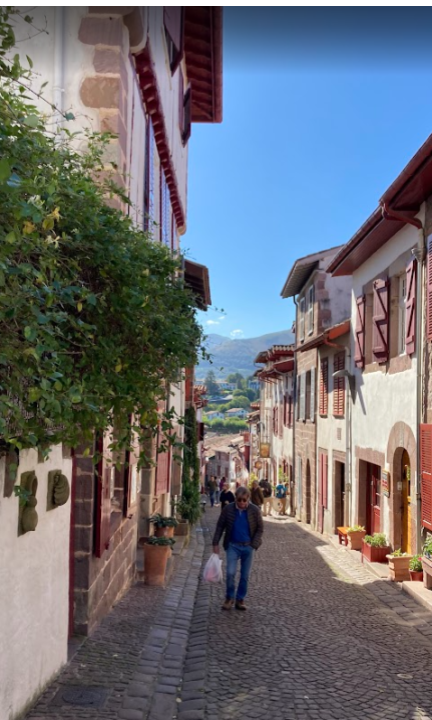
I am dragging the remains of my life through the ancient French town of Saint-Jean-Pied-de-Port. My existence has been distilled into one hundred pounds of personal detritus. Finally, I am within a few feet of my destination, but the pavement is no longer smooth. It has turned into rough cobblestones laid in shell-shaped patterns. This makes sense, I suppose; the scallop shell is the universal symbol of the Camino, and the road is telling me exactly where I am.
Five days ago, my husband boarded a bus in Cork bound for Dublin, and from there caught a flight to the United States.
Hence, the luggage.
I look at my two heavy pieces of luggage and then at the steep incline. I have no idea how I’m going to make it.
With him went my path to citizenship, my plans for retirement in the EU, and the final threads of a thirty-one-year marriage. To be fair, the marriage had been failing for years. My husband's decision to go to Utah to care for his mother was actually a relief—an unexpected exit from an emotional prison I hadn't realized I was inhabiting.
Before I fled, I was living in a monochrome world: a gray apartment in a gray city with gray carpet and a gray view. It is strange how we ignore our own misery until the mental clamor quiets and reflection becomes possible. Facing an Irish winter of dark, solitary days in that depressing flat, I felt a heavy, insistent racket in my head.
“Screw that,” I said. I made a decision and ran. I am running from the negative energy and hiding from the pain. But for the first time in months, I can think rationally.
I landed in the Basque region of France—a sunny, magical place so beautiful it stops my heart. Two weeks ago, I was an immigrant in Cork; today, I am a pilgrim in Saint-Jean, struggling to pull everything I own through a medieval street. As I haul my bags toward the Rue de la Citadelle, the customers at the outdoor cafes laugh. They are laughing at the silly woman with too much stuff.
Other pilgrims I met in Biarritz tried to warn me. “What kind of pilgrim has so much crap?” they asked. The typical traveler carries two of everything: two shirts, two pairs of socks, one rain poncho, and a pair of boots. My designer suitcase, stuffed with academic papers, memorabilia, and a lavender-scented stuffed animal, is not on the list of essentials.
Every day, two hundred people begin the Camino Francés—a five-hundred-mile trek across the Pyrenees and through northern Spain. We all shoulder something. Some need to heal souls; others, like me, need to outrun a life. We carry the ashes and essence of the people we love—or perhaps, it is the ones we love who are carrying us. That thought is the only thing that comforts me as I stare at the hill.
The climb is impossible in one go. I stop at a spice store on the corner of Rue de l’Église. The owner, God bless him, agrees to watch my suitcase while I move the first fifty pounds—my rucksack and day pack —up the hill. My pink polycarbonate luggage sits among baskets of aromatic spices, a charming visual contradiction.
I reach my lodging, Maison Simonenia, only to find it closed until 3:00 PM. Aw, shit. I drop the rucksack on the porch and retrace my steps to fetch the suitcase. To protect the wheels, I haul it inch by inch. Clack go the wheels, exhale goes my breath. I ignore the smirks of the "real" pilgrims passing me by. I am broken, yes, but I am here.
Later, once I am ensconced in my room, I meander to the pilgrim information office. Inside, the advisors are speaking French to a group of hikers in high-end technical gear. I feel the word bourgeois rise in my mind as I witness the bravado of the men. I take a breath, translating my English questions into French in my head, thankful for the language apps that have given me a fighting chance.
I reach the registry. Name? Susan. Nationality? Since the Irish scheme failed, "American" is my only option. Address? I hesitate. I won’t use the apartment in Cork; I never want to go back there. I don’t want to use my son's home in Fort Worth, either. I choose the address on my driver’s license: Georgetown, Texas. I haven't lived there in months, but it is the place I identify with most. If I am here to represent, I represent Texas.
“Bonjour. S’il vous plaît, je ne sais pas ce dont j’ai besoin,” I say to the advisor.
She is a stunning, elegant French woman with gray curls and wire-framed spectacles. She is poised, multilingual, and perfectly composed. I find myself wanting to be her.
“Where are you from?” she asks, switching effortlessly to English.
“The United States. Texas.”
“Which part?” she asks. “I lived in Houston for years.”
“Austin,” I say. It’s easier than explaining Georgetown.
“I like Austin,” she smiles.
She hands me a document outlining the 33 stages of the walk and tells me to start by 8:00 AM. She explains that the tap water is fine and I don't need to buy plastic bottles like other Americans. Then, she looks at me—really looks at me.
“You are educated,” she says matter-of-factly. “You will do fine.”
“Have you completed the Camino?” I ask.
She shrugs with that effortless French grace.
“Of course,” she says. “It is a requirement for advisors. Otherwise, how can we properly advise?”
I thank her and step outside into the late afternoon sun.
Tomorrow I will begin walking to Santiago.
Tonight I am still carrying everything.